
Customer Review of Making Myths: Jews in Early Christian Identity Formation
Customer photos 1
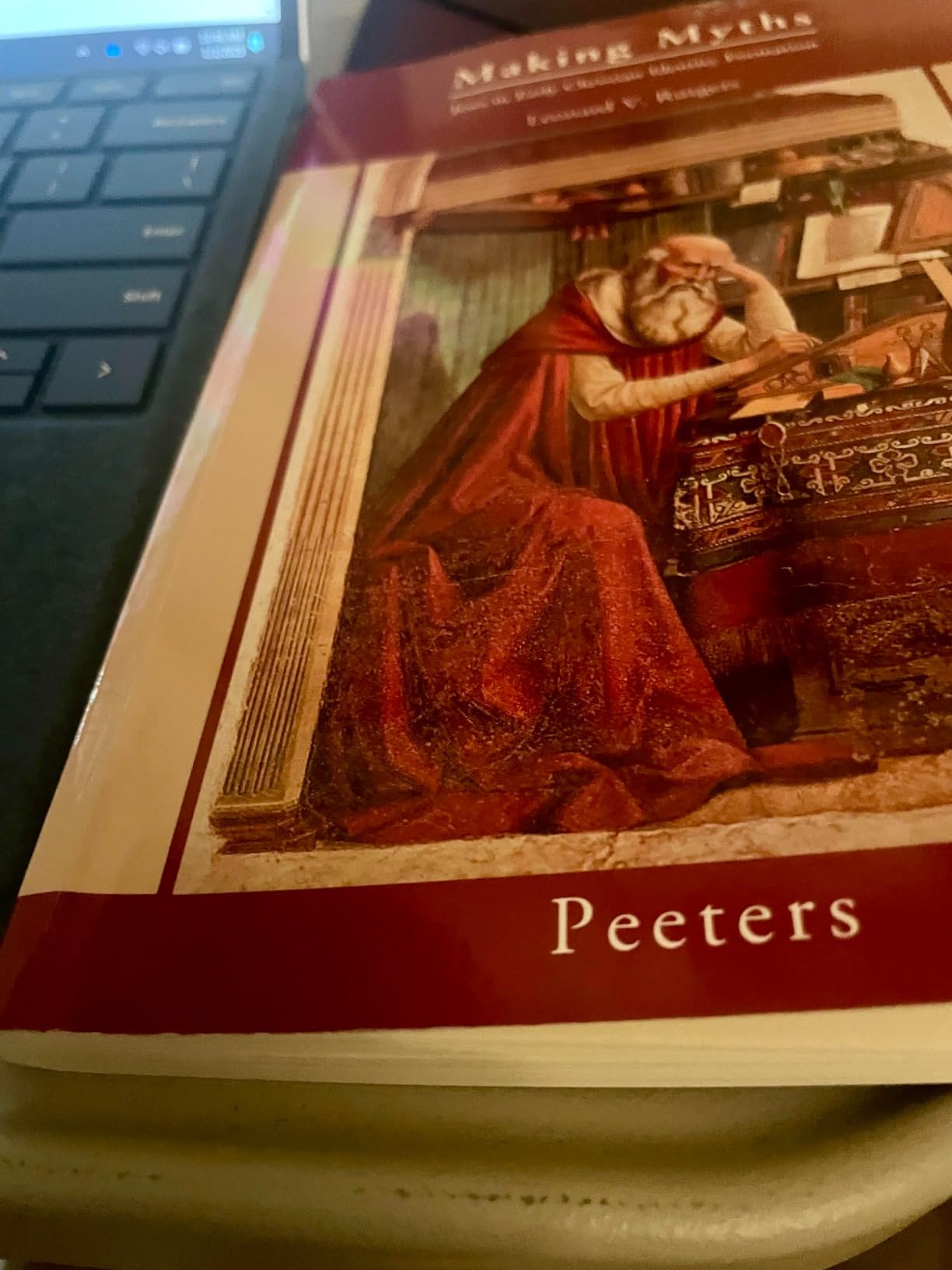
Select a photo to open the gallery.
Full customer review
Customer's headline
3 academic essays on early Christian objectification of Juddaism
The book is comprised of 3 pieces approx. 30 pages essays which focus on early Christian Church father's and law giving emperors' efforts to discredit and ultimately incapacitate or annihilate Judaism. Things i have learned: - The Maccabees, which gave Judaism Hannukah were the most venerated early Christian martyrs. - The Roman Law codices ( namely the Theodosian Code and the Justinian Code) which are taught in European Law Schools as examples for classic Roman law, are in fact heavily redacted works, which, - as is being pointed out in Rutgers' book - have a strong Christian bias. --> Additionally to clearly following anti Jewish legislation in Justinian's Novella 146 ( CH II) , the way in which Rutgers sheds light on the subtle corruption at work in the supposedly altruistic task of compiling the Theodosian and Justinian Codices in the 5th and 6th centuries CE is thought provoking. - In clear European secular manner, Rutgers analyzes the Church fathers Orwellian 'doublespeak' and uncovers their totalitarian motivations behind their feigned benevolence. - Even though this book is an academic discourse on Christian exegetical literature, Rutgers background in archeology has his work grounded in fact, which keeps his findings refreshingly in the realm of common sense. Areas I would have liked to know more about: - While a core finding in the book is that Early Christian Intellectuals created a hermeneutic Jewish stereotype to easier combat and ostracize the Jews in a fight, first for religious hegemony and ultimately exclusivity; - in a trade off for conciseness, Rutgers had to give up on the nuances within the early Church and Christianity in late antiquity appears more homogenous than I believe it was . Rutgers does point out Constantine I's dread of conciliar infighting, and the paradox of criticizing Judaism for its literal rather than allegorical reading of the bible, while inner Christian divergence from orthodox interpretation was heavily cracked down on. - I would like to hear Rutgers' thoughts on Jewish relations in the interplay of Christian sectarianism. 1. Were the relations of Jews with e.g.: Arian Christians ( who didn't venerate Jesus on the same level as God the father) more cordial then with Nicaean Christians? 2. Attack on the Jews and the appropriation of their Synagogues was definitely a battle cry to stand behind, but were Church father of North Africa, Syria and Milan, dealing with the same issues? Europe was ruled by Arian Christian monarchs until Gregory of Tours days. Are they also considered 'catholicam et apostolicam ecclesiam' i.e.: part of the one Church going back to the apostles? With all the schisms and sects, did the Roman church behave in unison with the Byzantine church? Far from being critical, my comments, i think. show the thought provoking topics Rutgers tackled in this slim volume. I'm looking forward to more publications from this author.
 Not for cats, not for tiny dog not for big dog but perfect for my 60 LB dog.
 The BEST EDC Bag in the world for a fraction of the price of other pretentious Tactical Bags
 Surprisingly awesome
 Fits "medium" sized hand. Annoying finger openings.
 The cleanest TV Wall Mount I've ever seen!
 Perfect, Stylish, shelf to install Inside your 12" Cabinet Door!